_edited.png)
The Ultimate Guide to Political Voice Broadcasting: High-Impact Voter Contact in 2026

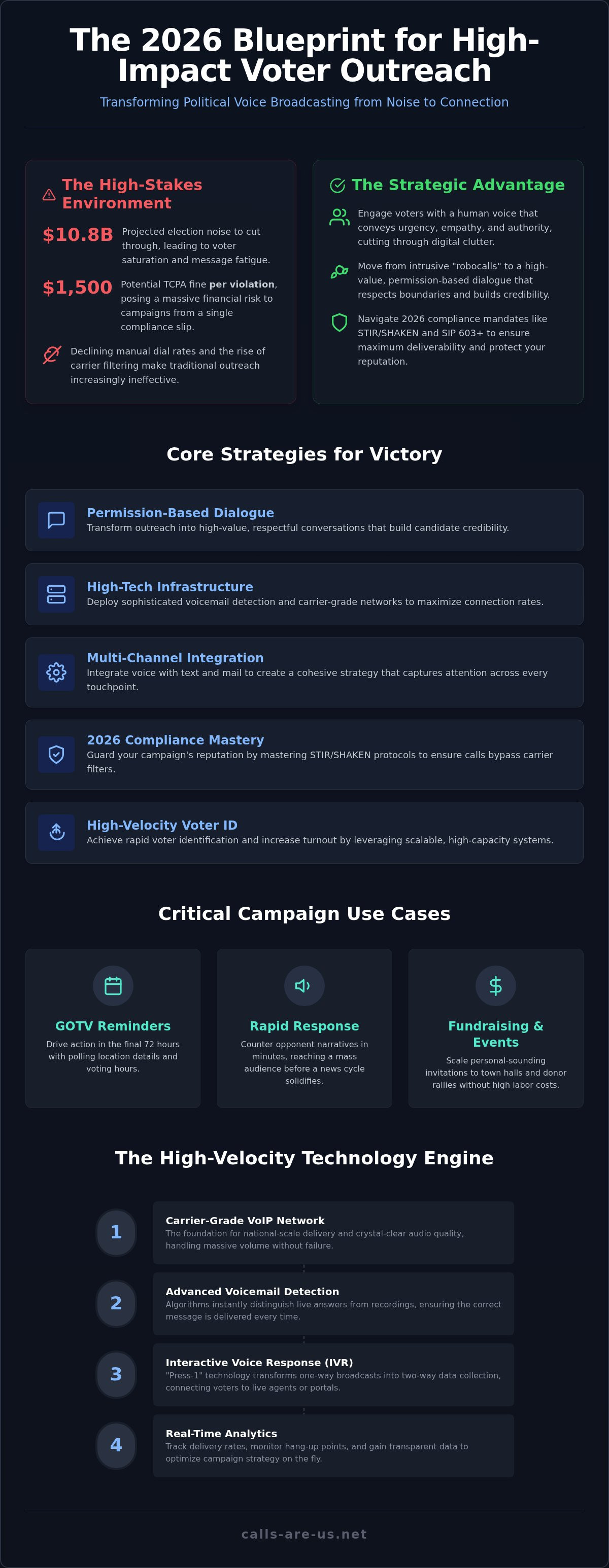
What if the most effective way to cut through the $10.8 billion noise of the 2026 election isn't a viral video, but a well-timed, human-centric phone call? In a world where digital feeds are saturated, political voice broadcasting remains a high-velocity tool for identifying supporters, mobilizing the base, and securing victory. You likely feel the pressure of declining manual dial rates and the looming threat of TCPA lawsuits that can cost up to $1,500 per violation. It's a high-stakes environment where one compliance slip can derail a campaign's momentum and its budget.
We believe that reaching voters should be an act of connection rather than a series of transactions. This guide provides the blueprint to master the technology, navigate the March 2026 SIP 603+ mandates, and execute high-impact voter contact with confidence. You'll learn how to leverage cost-effective mass communication to drive GOTV efforts and win on election day. We will explore the shift toward authentic vocal delivery, the latest FCC rulings on AI-generated content, and the precise workflows required to manage high-volume data with total precision.
Table of Contents
What is Political Voice Broadcasting? Beyond the Robocall Stigma
Political voice broadcasting is a high-velocity communication tool that delivers pre-recorded audio messages to thousands of voters simultaneously. It's the technical engine that powers modern mobilization. In 2026, we've seen a definitive shift away from the intrusive "robocall" stigma toward high-value, permission-based voter information. This isn't about spamming a list; it's about delivering timely, relevant content to a base that wants to hear from their candidates.
The human voice carries a unique weight that digital pixels simply can't replicate. It conveys urgency, empathy, and authority with a nuance that cuts through the noise of a crowded election cycle. By integrating these political communication strategies into your broader outreach, you create a sense of direct connection. This strategy serves as the backbone for voter identification and mobilization, ensuring your message reaches the right ears at the right moment.
To better understand how this technology operates at scale, watch this breakdown of modern voice calling software:
The Evolution of Automated Voter Contact
Technology has transformed simple playback into sophisticated interaction. Modern systems now utilize Interactive Voice Response (IVR) to gather real-time feedback from voters. We've moved from "one-to-many" broadcasting to "one-to-one" data collection at scale. In 2026, carrier-grade infrastructure ensures higher delivery rates and crystal-clear audio quality, even during peak traffic periods. Data-driven targeting allows campaigns to segment their audience with surgical precision, ensuring that a message about local infrastructure only reaches the affected district.
Common Use Cases for National Campaigns
Successful organizations use political voice broadcasting for more than just a single announcement. It's a versatile tool for several critical campaign functions. You can deploy it for:
GOTV Reminders: Drive immediate action by providing polling location details and voting hours in the final 72 hours of a race.
Rapid Response: Counter opponent narratives within minutes by reaching a mass audience before a news cycle can solidify.
Fundraising and Events: Scale personal-sounding invitations to town halls or donor rallies without the labor costs of manual dialing.
This infrastructure allows a campaign to maintain a constant, authoritative presence across multiple states simultaneously. It bridges the gap between high-level strategy and the individual voter's doorstep.
The High-Velocity Mechanics of Modern Political Outbound
Precision requires power. To execute a successful campaign in 2026, you need more than just a list of numbers; you need a carrier-grade VoIP network capable of national-scale delivery. Modern political voice broadcasting relies on these high-capacity pipelines to ensure messages reach voters without the latency or jitter that plagues consumer-grade systems. This infrastructure is specifically engineered to handle the massive volume required for national elections while maintaining crystal-clear audio quality. It's the difference between a message that resonates and one that's lost to technical failure.
Efficiency is the second pillar of a high-velocity campaign. Advanced algorithms now provide near-instant voicemail detection, allowing your system to distinguish between a live human answer and a digital recording. This ensures your message is delivered in full, whether it's played to a supporter or left as a concise reminder on an answering machine. You can also integrate "Press-1" technology to transform a one-way message into a dynamic interaction. This allows voters to connect directly with live agents, access donation portals, or confirm their attendance at an upcoming rally.
Data transparency provides the final layer of control. Real-time reporting and analytics allow your team to track delivery rates, monitor hang-up points, and record keypad responses as they happen. This level of visibility is essential for staying aligned with FCC regulations regarding call frequency and timing. By monitoring these metrics, you can refine your script and targeting strategy mid-campaign to maximize impact. If you want to see how these metrics translate into results, you can examine our high-capacity systems to better understand the scale required for modern success.
IVR and Data Collection
Automated polling is a force multiplier for resource-strapped campaigns. Using Interactive Voice Response (IVR), you can gather voter sentiment and identify key issues without the high overhead of live calling centers. This technology also facilitates patch-through calling, which connects constituents directly to their elected officials with a single keypress. These voter ID surveys are critical for cleaning your data, helping you distinguish between firm supporters, undecided voters, and staunch opponents before you invest in more expensive outreach methods.
Capacity and Scalability
Election Eve demands absolute reliability. National infrastructure must be able to handle sudden surges in traffic without compromising delivery speed or audio fidelity. High-capacity systems utilize load balancing and redundancy to prevent downtime, ensuring that your most critical messages go out exactly when they're needed. Modern platforms also integrate seamlessly with your existing CRM and voter file databases. This synchronization ensures that every call is logged and every response is updated in real-time, creating a unified view of your voter contact efforts across the entire organization.
Strategic Integration: When to Broadcast and When to Text
Outreach is a symphony, not a solo. Relying on a single channel in 2026 is a recipe for silence. A comprehensive voter outreach strategy requires multiple touchpoints to penetrate the daily digital fog. While digital ads and social media offer broad visibility, they lack the immediate, visceral impact of a human voice or the high open rates of a text message. Success depends on understanding which tool fits the specific moment of the campaign cycle.
Political voice broadcasting provides unparalleled urgency. When late-breaking news shifts the narrative or the final 72-hour Get Out The Vote push begins, the speed of audio delivery is unmatched. However, authenticity is paramount. Following the FCC’s ruling on AI-generated voices, campaigns must ensure their audio content is genuine and compliant. This builds the trust necessary to move a voter from passive awareness to active participation.
Texting serves as the primary engine for ongoing dialogue and high-engagement interaction. You must decide between P2P vs broadcast texting based on your specific goals. P2P is ideal for nuanced conversations, while broadcast texting excels at scale. To anchor these digital efforts, a political direct mail strategy provides a tangible, permanent reminder that sits on a voter's kitchen table. This physical presence reinforces the urgency of your voice and text messages.
The Voter Journey Framework
A voter's path to the ballot box follows a predictable arc. During the awareness phase, use direct mail and broad voice announcements to establish name recognition. As you move into the persuasion phase, pivot to P2P texting and interactive IVR polling to gauge sentiment and address concerns. Finally, the mobilization phase demands high-velocity political voice broadcasting and SMS reminders. This progression ensures you aren't just shouting; you're guiding the voter toward a firm decision.
Cost-Effectiveness and ROI
Efficiency drives victory. Automated voice tools offer a significantly lower cost-per-contact compared to live agents. By using these systems for the initial touch, you can filter your list and identify high-value targets. This allows you to allocate your most expensive resources, such as live call centers, to voters with the highest engagement scores. This strategic layering ensures every dollar in your budget works toward maximum turnout rather than being wasted on unengaged leads.
Compliance and Execution: Navigating the 2026 Regulatory Landscape
Integrity is the foundation of influence. In 2026, the regulatory environment for political voice broadcasting is more rigorous than ever before. You must balance aggressive outreach with strict adherence to the Telephone Consumer Protection Act (TCPA). While landlines offer more flexibility, automated calls to mobile phones are strictly prohibited without prior express written consent. Violating these boundaries doesn't just result in fines; it erodes the very trust you're working to build with the electorate.
Visibility depends on verification. The March 2026 SIP 603+ mandate has fundamentally changed how carriers handle unverified traffic. To avoid the dreaded "Spam Likely" tag, your campaign must implement full STIR/SHAKEN authentication. This technical handshake proves to carriers that your caller ID is legitimate and your intentions are transparent. Additionally, every recorded message must include legally required disclaimers. You must identify the sponsoring organization, provide a valid callback number, and state the purpose of the call clearly.
Respect the voter's schedule. Federal law restricts political calls to the hours between 8 a.m. and 9 p.m. in the recipient's local time zone. Managing this across multiple states requires a system that is geographically aware and operationally precise. Failure to respect these windows can lead to swift regulatory action and significant voter backlash. To ensure your campaign remains on the right side of the law, it's vital to partner with experts who specialize in political call compliance.
Managing Your Opt-Outs
Consent is a dynamic relationship. As of April 2025, voters can revoke consent in any reasonable manner, and campaigns must honor these requests within 10 business days. We utilize automated DNC list management to ensure your database stays current and compliant. Providing a simple keypad opt-out during the call empowers the voter and prevents future friction. True sophistication comes from synchronizing these opt-outs across voice, text, and email, creating a seamless and respectful experience for every constituent.
Carrier Relations and Filtering
Deliverability is the new currency of outreach. The introduction of 10DLC registration has streamlined the communication ecosystem, but it requires proactive management. If your numbers are flagged, you need a remediation strategy that addresses carrier concerns immediately. Working with a provider that understands the nuances of 2026 carrier relations is the only way to protect your reputation. You can consult our compliance experts to audit your current strategy and ensure your messages actually reach the voter.
Scaling Your Influence with Calls-Are-Us Infrastructure
Victory in 2026 requires more than just software; it demands a partnership built on infrastructure and insight. Calls-Are-Us serves as the authoritative partner for national organizations that refuse to leave their voter contact to chance. While others offer basic dialing tools, we provide a high-capacity political campaign call center infrastructure designed to withstand the most intense election cycles. We believe that technology should foster genuine connection rather than just creating noise. Our commitment to ethical, impactful, and compliant communication ensures that your campaign's reputation remains as strong as your message.
Execution at scale is our specialty. Since our founding circa 2010, we've refined the art of political voice broadcasting to meet the needs of high-stakes environments. We don't just facilitate calls; we facilitate transformation. By prioritizing human-centric technology, we help you bridge the gap between high-level data and the individual voter's experience. This approach turns a simple notification into a powerful moment of mobilization that drives results on election day.
The Calls-Are-Us Difference
Expertise is our greatest asset. We don't just provide the tool; we guide the strategy behind every dial. With proven reliability in over 40 states, our team understands the unique pressures of national election cycles and public affairs. We offer a seamless integration of voice, text, and mail to create a unified mass communication strategy. This multi-channel synergy ensures that your message is heard, felt, and remembered across every possible touchpoint.
Launching Your 2026 Campaign
Success starts with a plan. Our onboarding process includes comprehensive script optimization to ensure your political voice broadcasting efforts achieve maximum impact from the very first call. We provide real-time support during critical election windows, ensuring that your infrastructure remains resilient when the pressure is highest. Our team monitors delivery rates and compliance metrics constantly, allowing you to focus on the broader vision of your campaign. It's time to move beyond traditional outreach and embrace a more sophisticated way to win. You can Empower your campaign with Calls-Are-Us today and start building the connections that will define your victory.
Mastering the Future of Voter Engagement
Success in the 2026 election cycle hinges on your ability to transform raw data into resonant human connections. We've explored how political voice broadcasting has evolved from a blunt instrument into a precision-guided engagement engine. By prioritizing rigorous compliance through STIR/SHAKEN protocols and integrating audio outreach with text and mail, you create a cohesive narrative that voters can trust. This multi-channel approach ensures your message isn't just delivered; it's actually heard by the right people at the right time.
The stakes of national leadership demand a partner with the capacity to deliver under pressure. With operations in over 40 states and a national high-volume infrastructure, Calls-Are-Us provides the stability your organization needs to mobilize the base effectively. We don't just offer tools; we offer a visionary path toward ethical and impactful communication. It's time to scale your outreach with our professional voice broadcasting solutions and secure your place at the forefront of the political landscape. Your mission deserves a voice that carries the weight of authority and the warmth of partnership.
Frequently Asked Questions
Is political voice broadcasting legal under TCPA regulations?
Yes, political voice broadcasting is legal, but it's governed by specific TCPA and FCC guidelines that distinguish between landlines and mobile phones. For residential landlines, campaigns are generally permitted to deliver non-commercial, political messages. However, you must still adhere to time-of-day restrictions and include required identification disclosures to maintain full legal compliance during the 2026 cycle.
Can I send voice broadcasts to mobile phones for my campaign?
You cannot send automated voice broadcasts to mobile phones without prior express written consent from the recipient. Federal law is very strict on this point to protect consumer privacy. If your campaign doesn't have documented permission, you should pivot to peer-to-peer texting or live calling to reach those specific voters safely without risking substantial regulatory fines.
What is a 'Press-1' campaign and how does it work?
A 'Press-1' campaign is an interactive broadcast that allows voters to take immediate action by pressing a key on their phone. When a voter presses '1', the system can instantly route them to a live representative, a donation portal, or an IVR menu. It's a powerful way to convert a passive listener into an active participant or donor during a single interaction.
How much does political voice broadcasting typically cost?
Pricing for political voice broadcasting depends on several factors, including total call volume, message duration, and required delivery speed. Because every campaign has unique infrastructure needs and data requirements, we provide customized quotes rather than a flat rate. Factors like STIR/SHAKEN attestation and carrier-grade delivery also influence the final investment needed for a successful outreach program.
How do I prevent my campaign calls from being marked as 'Spam Likely'?
Preventing 'Spam Likely' tags requires full STIR/SHAKEN authentication and proactive number reputation management. You should work with a provider that uses registered 10DLC numbers and monitors carrier feedback in real-time. Maintaining a low hang-up rate through high-quality, relevant content also helps keep your caller ID clean across major mobile networks and ensures higher connection rates.
What is the difference between a robocall and a strategic voice broadcast?
The difference lies in intent, targeting, and value. A robocall is often perceived as an intrusive, untargeted message sent to a broad list without context. A strategic voice broadcast uses precision data to deliver helpful information, such as polling place reminders or urgent policy updates, to voters who have an existing relationship with the candidate or organization.
How many calls can Calls-Are-Us handle per hour for a national campaign?
We operate a national high-volume infrastructure capable of delivering hundreds of thousands of calls per hour. This massive scale is essential for Election Eve surges when campaigns need to reach an entire state's worth of supporters in a very narrow window. Our load-balanced systems ensure that your audio quality remains clear even during these peak traffic periods.
Do I need a special disclaimer in my recorded political message?
Yes, every recorded message used in political voice broadcasting must include a specific disclaimer identifying the person or organization responsible for the call. You must state the sponsoring entity's name clearly and provide a valid telephone number for that organization. These disclosures are a mandatory part of federal regulations and help maintain transparency with the electorate.



Comments