_edited.png)
The Ultimate Guide to Political Voice Broadcasting in 2026

Updated: Jul 19
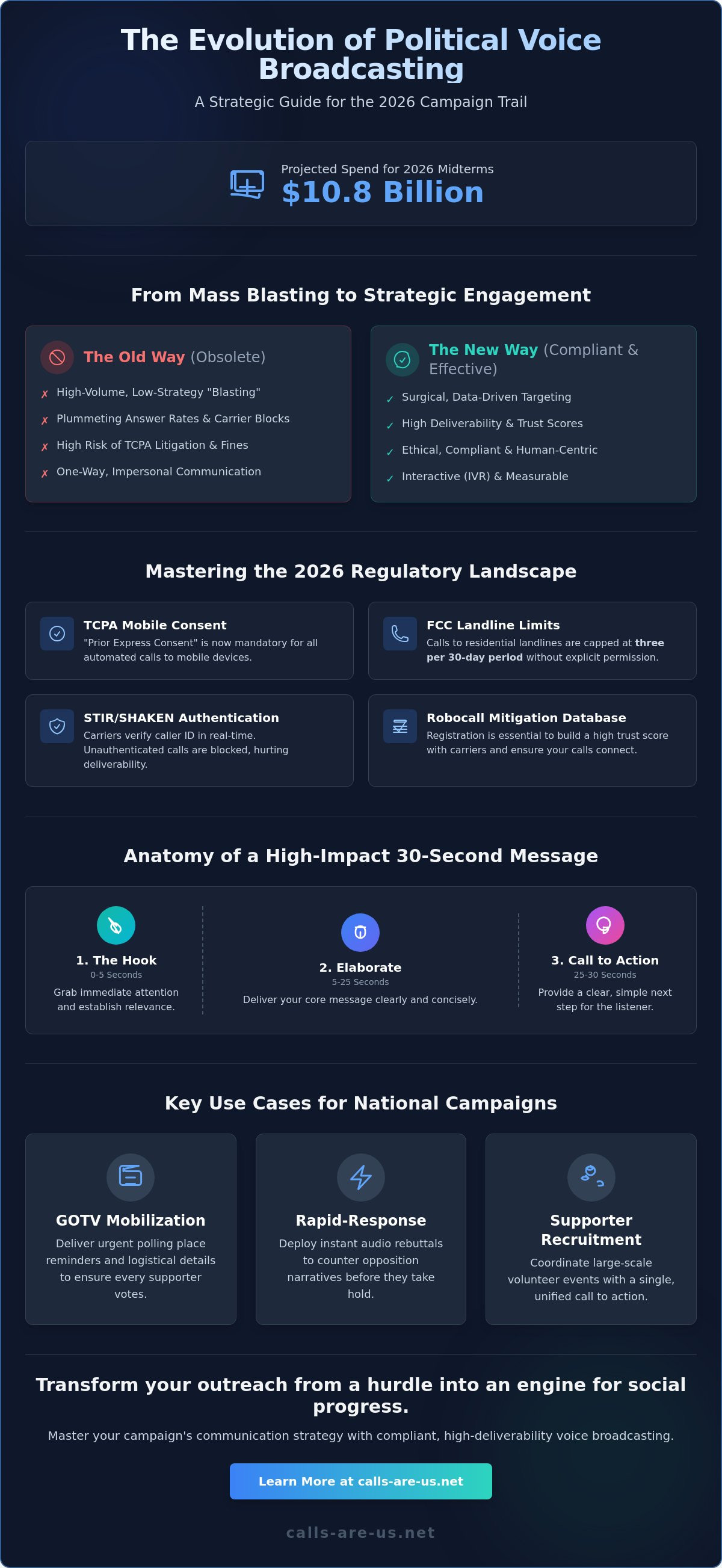
The era of high-volume, low-strategy robocalling is officially over. With a projected $10.8 billion spend for the 2026 midterms, the fight for voter attention has never been more expensive or more strictly regulated. You've likely felt the frustration of declining answer rates, the complexity of carrier filtering, and the looming shadow of TCPA litigation. With the FCC now classifying AI-generated voices as artificial and limiting landline contacts to three per month, the old tactics are obsolete. Modern political voice broadcasting isn't about blasting noise; it's about strategic, compliant, and human-centric amplification. It requires a sophisticated balance of technological precision, legal awareness, and ethical outreach to ensure your message actually lands.
We know you're looking for a way to connect without the risk of heavy fines or blocked numbers. This guide provides the roadmap to master the technology, regulations, and messaging strategies required to reach thousands of voters instantly and ethically. We'll explore how to achieve high deliverability, maintain seamless CRM synchronization, and drive measurable voter turnout. By the end of this article, you'll understand how to register with the Robocall Mitigation Database, navigate the latest consent requirements, and craft messages that foster genuine connection. It's time to transform your outreach from a technical hurdle into a powerful engine for social progress.
Table of Contents
The Strategic Role of Political Voice Broadcasting in 2026
Precision defines the 2026 campaign trail. Political voice broadcasting has evolved from a blunt instrument into a surgical tool for national influence. It functions as a high-volume, automated audio communication system that delivers pre-recorded messages to thousands of voters simultaneously. While some might ask, What is a Robocall? to understand the technical roots, modern practitioners view this technology as the backbone of rapid mobilization. In an era where digital noise is deafening, the human voice remains the fastest way to cut through the static, command immediate attention, and drive action.
We've moved beyond the era of indiscriminate "blasts." The 2026 landscape demands a transition to strategic audio engagement. This shift prioritizes data-driven targeting over sheer volume, ensuring that every dial serves a specific purpose. To achieve true resonance, campaigns must integrate voice with peer-to-peer (P2P) texting and direct mail. This multi-channel approach creates a cohesive ecosystem where a voice call reinforces a physical mailer, and a P2P text provides the final, clickable call to action. It is a formula for comprehensive utility that respects the voter's time while maximizing campaign impact.
Beyond the Robocall: The Modern Engagement Model
Engagement is a two-way street. Old-school methods relied on one-way dissemination, but the modern model utilizes Interactive Voice Response (IVR) to foster dialogue. IVR allows voters to provide instant feedback, answer poll questions, or request more information by pressing a single digit. This technology bridges the gap between passive digital ads and static physical mail. It transforms a simple broadcast into a dynamic interaction, providing campaigns with real-time data that traditional channels simply cannot match. By treating voice as a central hub in a broader digital strategy, you create a seamless journey from awareness to the ballot box.
Core Use Cases for National Political Campaigns
Speed wins elections. Voice broadcasting excels in high-pressure scenarios where hours, not days, make the difference. Campaigns that master this tool can pivot instantly, mobilize resources, and protect their narrative against sudden attacks.
GOTV Mobilization: Deliver urgent polling place reminders and logistical details to ensure every supporter reaches the ballot box on election day.
Rapid-Response Messaging: Deploy instant audio rebuttals to counter opposition narratives before they take root in the public consciousness.
Supporter Recruitment: Coordinate large-scale volunteer events by reaching thousands of potential advocates with a single, unified call to action.
These strategies don't just reach people; they move them. When you combine the speed of automation with the intimacy of the human voice, you create a powerful catalyst for voter turnout. It's about building a bridge between your message and the people who need to hear it most.
Navigating the 2026 Regulatory Landscape and Compliance
Compliance is your campaign's most valuable asset. In 2026, the legal framework surrounding political voice broadcasting has shifted from a set of guidelines into a strictly enforced mandate. The Telephone Consumer Protection Act (TCPA) now requires prior express consent for all automated calls to mobile devices. Additionally, as of early 2026, calls to residential landlines are capped at three per 30-day period unless you have explicit permission. These rules don't just exist to penalize; they exist to ensure that your outreach remains respectful, ethical, and effective.
Authentication is the key to reaching the ear of the voter. The implementation of STIR/SHAKEN protocols means that carriers now verify the identity of every caller in real-time. If your digital handshake is weak, your calls won't just be ignored; they'll be blocked before the phone even rings. Maintaining a high trust score requires registering with the Robocall Mitigation Database and ensuring your caller ID information is accurate and consistent. This level of transparency is essential for any campaign that values integrity and results.
The TCPA Survival Checklist for Campaigns
Success requires a methodical approach to legal boundaries. Every campaign must internalize three pillars of compliance to protect their reputation and their budget. First, you must maintain an up-to-date Internal Do Not Call (DNC) list that honors every opt-out request immediately. Second, strictly adhere to time-of-day restrictions, as legal broadcasts are only permitted between 8 a.m. and 9 p.m. in the recipient's local time zone. Finally, ensure every pre-recorded message identifies the entity responsible for the call at the start and provides a clear contact number for the campaign.
Ensuring Deliverability in a Filtered Environment
Avoid the "Scam Likely" label at all costs. Carriers use sophisticated algorithms to filter out high-volume traffic that mimics spam patterns. To maintain a pristine reputation, you must rotate outbound numbers strategically and monitor your caller ID health daily. Using consumer-level tools is no longer viable for national outreach. You need a compliant dialing infrastructure that integrates directly with carrier protocols to ensure your voice actually reaches the voter. This professional-grade approach bypasses common blocks and ensures that your message is delivered with the authority it deserves. By prioritizing ethical communication, you don't just follow the law; you build a foundation of trust with the electorate.
Dialer Dynamics: Choosing the Right Technology for Your Goals
Technology acts as a catalyst for your campaign's vision. Selecting the specific dialing mechanism is more than a logistical choice; it is the foundation of your voter relationship strategy. While some platforms focus exclusively on agent-led conversations, a truly comprehensive approach leverages the speed of political voice broadcasting alongside the nuance of live interactions. Integrating these tools with a central CRM, such as NGP VAN, ensures that every interaction is recorded, analyzed, and utilized for future outreach. This synchronization eliminates data silos and allows your team to move with agility, precision, and purpose.
Efficiency is the driver of modern field operations. When you sync your dialer with your voter file, you create a closed-loop system where data flows in real-time. This means a voter who indicates they've already cast their ballot via an automated survey is immediately removed from your GOTV list. This level of operational maturity prevents wasted resources and ensures your volunteers focus their energy where it matters most. It's about being both technologically savvy and deeply respectful of the voter's experience.
Automated Broadcasts vs. Live Agent Transfers
Reach thousands in seconds. Purely automated broadcasts are the gold standard for delivering time-sensitive information, such as polling location changes or emergency rapid-response alerts. These messages offer the lowest cost-per-contact, making them ideal for wide-scale awareness and mobilization. However, when the goal shifts to persuasion or fundraising, "Press-1" campaigns provide a vital bridge. By allowing a voter to press a single digit to speak with a representative in your live calling center, you combine the reach of automation with the persuasive power of a human voice. This hybrid model empowers your supporters to take immediate action while keeping your operational costs manageable.
IVR: Turning Broadcasts into Data Engines
Every call is a data opportunity. Interactive Voice Response (IVR) systems transform standard political voice broadcasting into sophisticated voter ID engines. Instead of simply speaking to the voter, you invite them to participate through simple keypad inputs. This technology facilitates instant polling, volunteer recruitment, and opt-in collection for subsequent mass texting or direct mail campaigns. You can structure these interactions to achieve three specific goals:
Identify undecided voters through automated survey questions that feed directly into your CRM.
Collect digital consent for future peer-to-peer texting outreach to maintain TCPA compliance.
Route potential volunteers to specific departments based on their skills or geographic location.
This methodical approach to data collection ensures that your campaign remains an authoritative visionary in the field. By utilizing IVR as a diagnostic tool, you ensure that every subsequent communication is more relevant, more personal, and more impactful than the last. It's not just about making calls; it's about building a smarter campaign.
The Anatomy of a High-Impact Political Broadcast Message
Words carry the weight of your campaign's entire mission. While the technical infrastructure of political voice broadcasting provides the reach, the script provides the resonance. A 30-second audio message must do more than relay facts; it must spark a relationship. We utilize a hook-and-elaborate structure to ensure every second counts. You begin with a punchy, assertive statement that captures immediate interest, followed by a more detailed explanation that provides the necessary context. This rhythm keeps the voter engaged while respecting the brief window of their attention.
Choosing the right voice is a strategic decision. A candidate’s own recording often carries higher emotional weight and authenticity, making it ideal for personal appeals or the legal "Stand by Your Ad" requirements. Conversely, a professional voice talent offers the precision and clarity needed for complex logistical instructions or rapid-response alerts. Regardless of the speaker, the language must remain humanistic. Avoid cold, transactional jargon. Use terms that emphasize community, shared progress, and mutual trust to bridge the gap between automation and human connection.
Scripting for Retention: The First 5 Seconds
You have five seconds to prove your relevance. The opening line must serve as an immediate hook that prevents the voter from hanging up. Personalizing the greeting with the recipient's name significantly increases perceived value. Establish your authority and intent within that first sentence. If you don't clearly state who you are and why you're calling, you've already lost the interaction. A well-crafted opening transforms a potential interruption into a meaningful notification.
Emotional Resonance and the "Visionary" Tone
Move from transactional data to value-driven storytelling. A visionary tone focuses on the potential for impact rather than just the mechanics of voting. We recommend using tripartite structures to create a sense of rhythm and comprehensive utility. Grouping three benefits or actions together, such as voting for change, protecting our values, and building a better tomorrow, makes your message more memorable and persuasive. Balance the urgency of a Get Out The Vote (GOTV) push with themes of social responsibility and inclusivity. This approach ensures your political voice broadcasting campaign feels like a principled guide rather than a simple advertisement.
Every word in your script should lead toward a single, decisive action. Don't dilute your impact by offering multiple choices. Whether you want them to "Press 1" for a volunteer or "Mark their calendar" for Tuesday, keep the directive singular and clear. If you're ready to deploy messages that actually move the needle, you need to start your campaign with a professional broadcasting partner today. This ensures your high-impact scripts are delivered through a platform built for maximum voter engagement and measurable turnout.
Scaling Your Influence: The Calls-Are-Us Advantage
Scale is the ultimate test of a campaign's infrastructure. Winning at a national level requires more than just high-volume tools; it requires a partner who understands the high-stakes environment of 2026. Calls-Are-Us operates as an authoritative visionary, bridging the gap between sophisticated technology and human connection. Our platform is built to support massive multi-state campaigns, ensuring your message reaches every corner of the country without sacrificing the intimacy of a local conversation. We don't just provide a service. We champion a philosophy of inclusive dialogue and ethical outreach.
Efficiency drives momentum. When you deploy political voice broadcasting through our network, you aren't just sending a recorded message; you're initiating a movement. Our infrastructure handles the technical heavy lifting, from carrier reputation management to real-time CRM synchronization. This allows your team to focus on what matters most: the strategy and the story. By choosing a partner with proven worth in high-pressure environments, you ensure that your campaign remains bold, decisive, and ahead of the curve.
National Reach with Personalized Precision
Capacity meets compliance. Our high-volume systems are engineered to handle the most demanding election cycles, delivering thousands of messages per minute while adhering to the latest regulatory shifts. We provide seasoned expert support to help you navigate the complexities of the Robocall Mitigation Database and 2026 TCPA mandates. This level of partnership acts as a principled guide, helping you avoid the pitfalls of carrier filtering and legal challenges. We believe that every dial should foster trust, encourage dialogue, and drive social progress. By prioritizing ethical communication, we help you realize a measurable impact that transcends simple metrics.
The Integrated Outreach Roadmap
Influence is built through repetition and variety. A single touchpoint is rarely enough to secure a vote in a contested environment. Instead, we advocate for an integrated ecosystem that surrounds the voter with consistent, value-driven messaging. This roadmap ensures your campaign remains top-of-mind from the first primary to the final general election tally. Our tripartite approach creates a sense of comprehensive utility and rhythm:
Start with political voice broadcasting to identify supporter leanings and gather initial voter ID data.
Follow with peer-to-peer texting to provide personalized persuasion and answer specific policy questions.
Close the loop with direct mail to establish a tangible, physical presence in the voter's home.
The complexities of 2026 demand more than a software subscription. You need a strategic ally committed to your success and the broader social good. Consult with our outreach strategists today to build a communication plan that is bold, decisive, and fully compliant. It's time to transform your outreach from a technical hurdle into a powerful engine for voter mobilization.
Leading Your Campaign to Victory in 2026
Winning requires more than just volume. It demands a strategic partner who can transform complex technology into a seamless engine for voter mobilization. We've explored the necessity of regulatory mastery, the power of data-driven IVR, and the impact of human-centric messaging. Now, it's time to put these strategies into action. Modern political voice broadcasting is your most effective tool for rapid response and wide-scale connection; however, its true potential is only realized through ethical, compliant, and integrated outreach.
Calls-Are-Us stands ready to serve as your authoritative visionary in the field. We currently operate in 40+ states, supporting both national and local elections with high-volume infrastructure. Our team handles full TCPA and 10DLC compliance management, allowing you to focus on your message while we protect your reputation. By combining voice, text, and direct mail, we provide a rhythmic, multi-channel presence that voters can trust. Empower your campaign with compliant, high-impact voice broadcasting today. Let's build a future defined by meaningful interactions and measurable turnout together.
Frequently Asked Questions
Is political voice broadcasting still legal in 2026?
Yes, it remains a legal and effective tool for voter mobilization in 2026. You must adhere to the Telephone Consumer Protection Act (TCPA) and the latest FCC rulings. These regulations require prior express consent for calls to mobile phones and limit residential landline contacts to three within any 30-day period. Staying compliant ensures your campaign maintains integrity while reaching the electorate.
How do I ensure my political calls are not marked as spam?
Maintaining a high trust score is the most effective way to avoid "Scam Likely" labels. You must register with the Robocall Mitigation Database and implement STIR/SHAKEN protocols to authenticate your identity with carriers. Rotating outbound numbers and monitoring your reputation daily prevents algorithmic filtering. This professional approach protects your deliverability and ensures your voice reaches the intended audience.
What is the difference between a robocall and a voice broadcast?
The difference lies primarily in strategy and intent rather than just the technical delivery. A robocall is a broad technical term for any automated call; however, political voice broadcasting refers to a strategic, data-driven outreach effort. While traditional robocalls often prioritize sheer volume, modern broadcasting focuses on targeted engagement, legal compliance, and multi-channel integration. It's the difference between making noise and making a genuine connection.
Can I use voice broadcasting for political fundraising?
You can absolutely utilize voice broadcasting to drive your fundraising efforts. It works best when combined with Interactive Voice Response (IVR) to allow voters to "Press 1" and speak directly with a live agent in your calling center. This hybrid model allows you to scale your outreach while maintaining the personal touch necessary for high-stakes donor cultivation. It's a powerful engine for building the resources your campaign needs to win.
How much does a national political voice broadcast campaign cost?
Costs vary based on message length, dial volume, and the complexity of your targeting. Most campaigns budget based on a per-connected-call or per-minute model that reflects the scale of their operation. We recommend consulting with an outreach specialist to develop a customized quote tailored to your specific multi-state or local requirements. This ensures your budget is allocated efficiently to maximize voter engagement and turnout.
Do I need a voter file to start a voice broadcast campaign?
A high-quality voter file is essential for a successful and compliant campaign. Accurate data allows you to target specific demographics, honor opt-out requests, and manage the 30-day contact cap for landlines. Without a robust list, your outreach lacks the precision needed to move the needle. Starting with a verified file ensures every dial contributes to your broader mobilization strategy and respects the voter's experience.
What are the TCPA disclosure requirements for political calls?
Every pre-recorded message must include specific legal disclosures to remain compliant. You're required to state the name of the organization responsible for the call at the very beginning of the recording. Additionally, you must provide a clear, reliable contact phone number during or after the message. These disclosures build transparency and trust with the voters you're working to reach while satisfying federal mandates.
Can voice broadcasting integrate with my campaign CRM?
Seamless integration with CRMs like NGP VAN is a standard feature for professional-grade political voice broadcasting platforms. This connectivity allows for real-time data synchronization; it ensures that voter responses and opt-outs are recorded instantly across your entire organization. It eliminates manual data entry and empowers your team to make informed decisions with the most current information available. Integration is the key to a truly agile campaign.



Comments