
Why My Last Direct Mail Campaign Failed: A Practical Post-Campaign Guide

What if the problem with your last mailing wasn’t the design? If you’re asking why my last direct mail campaign failed, it’s tempting to blame the piece or the offer. But low response is a clue, not a diagnosis. Audience fit, timing, delivery, and the response process can all affect results. Other outreach may also make it harder to tell which touchpoint prompted a reply.
It’s frustrating to invest in a campaign and still be unsure what worked. A quiet response doesn’t automatically mean direct mail failed. Expectations, measurement, or the time allowed for responses may need a closer look, too. Review the evidence before changing everything at once.
This guide helps you assess likely causes, distinguish underperformance from unrealistic expectations, and set clearer success measures before your next mailing. You’ll review audience fit, offer, creative, timing, delivery, and attribution, then consider practical adjustments and complementary follow-up channels. The aim is to make your next effort easier to measure and learn from.
Table of Contents
Why your direct mail campaign may have failed, and what to check first
Six direct mail failure points: audience, offer, message, timing, delivery, and follow-up
How to interpret direct mail results without misleading yourself
A practical post-mortem: turn campaign evidence into a better test
When direct mail needs coordinated follow-up to complete the conversation
Why your direct mail campaign may have failed, and what to check first
A disappointing response can feel like a clear verdict: the mailing didn’t work. Before rewriting the piece or abandoning the channel, check what the campaign was meant to achieve and what the evidence can actually tell you. If you’re asking “why my last direct mail campaign failed,” start with the objective, audience, delivery status, response window, and measurement method. Each affects how you should interpret the result.
Keep the diagnosis focused. First, establish whether the mail reached its intended audience and whether recipients had enough time to respond. Then consider audience fit, offer, message, and response path. A low response count alone can’t identify the cause. A low response is an observation; an undiagnosed cause is still a question.
For broader context on how mail is created and targeted, see Advertising mail, also known as direct mail. To hear another perspective on diagnosing an underperforming mailing, watch:
Was the campaign unsuccessful, or were expectations unclear?
Return to the success criteria set before the campaign. Was the goal to generate inquiries, qualified leads, completed transactions, or awareness? Compare results with that goal, not with a different measure chosen after the campaign. Response volume and response value also tell different stories. Fewer replies may still include the high-quality opportunities the campaign was designed to attract.
Use external response-rate benchmarks only as context. Results vary with audience type, offer, timing, and response method, so a published figure isn’t automatically the right target for your mailing. Before using one, check its source, publication date, and how its campaign conditions compare with yours.
Then confirm the response window. If the campaign hasn’t had the full period you planned to allow, label the results preliminary rather than final. This prevents a slow response from being treated as proof of failure.
Build a quick post-campaign evidence file
Gather records before deciding what went wrong. Keep the approved mail piece, audience definition, drop dates, and available delivery information together with response records, call logs, landing-page visits, and campaign notes. A compact evidence file makes it easier to compare what was planned with what happened.
Note the campaign objective and how success was defined.
Record the audience and quantity mailed, plus any available delivery information.
Collect response activity across the channels used during the campaign.
Flag results you can’t confidently attribute to the mail piece.
That last step matters. If someone responded after seeing both a mail piece and another outreach message, don’t credit one channel without supporting evidence. Mark attribution as uncertain, separate confirmed responses from possible ones, and carry that uncertainty into the review. A careful record is more useful than a confident guess.
Six direct mail failure points: audience, offer, message, timing, delivery, and follow-up
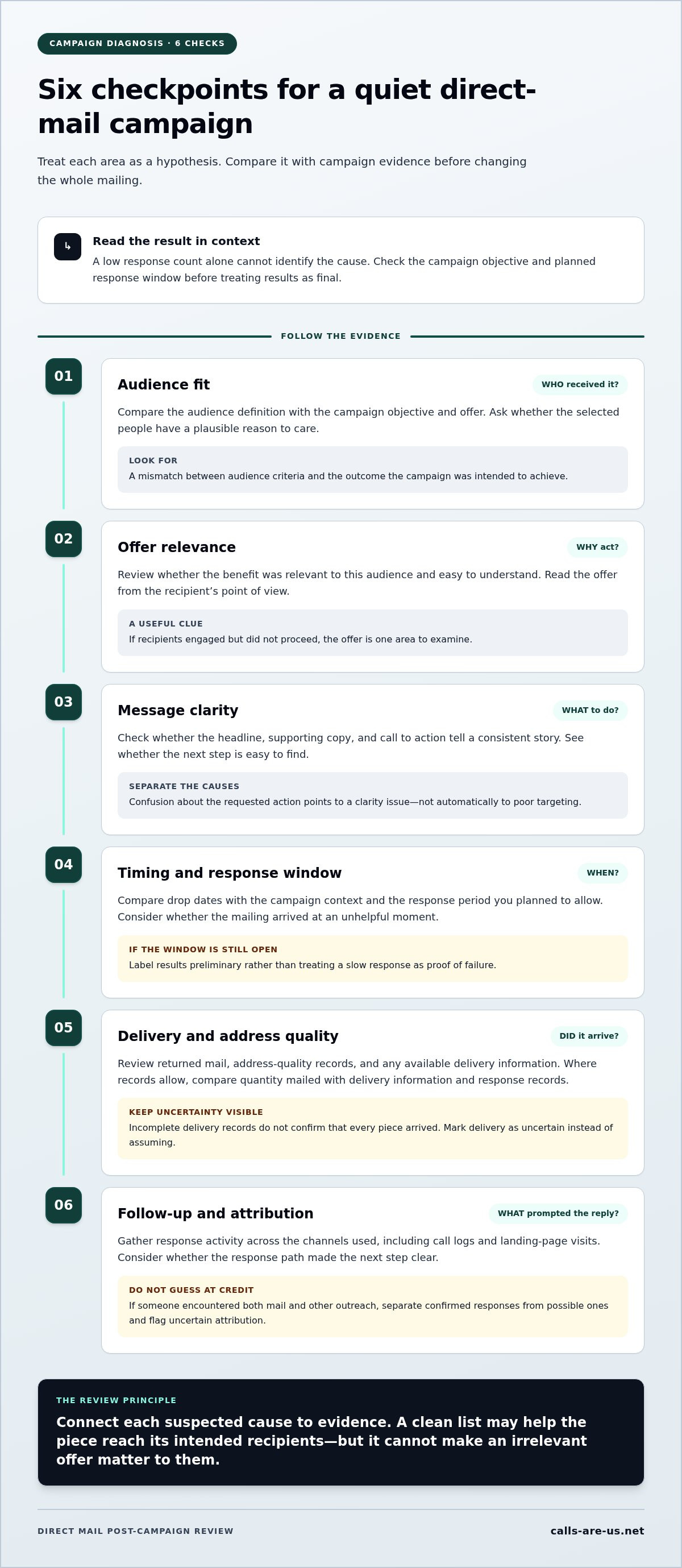
Don’t treat a quiet campaign as proof that every part of it was wrong. If you’re asking why my last direct mail campaign failed, use these six areas as hypotheses and look for evidence that supports or weakens each one. A delivery issue may leave few people able to respond. A poor audience match may mean the piece reached people with little reason to act. An unclear message or call to action is different: the right people may have received the mail but not understood what to do next.
A clean list can help a piece reach its intended recipients, but it can’t make an irrelevant offer matter to them. Connect symptoms to records instead of blaming the most visible part of the campaign.
Audience, address quality, and delivery
Compare the audience definition with the campaign objective and offer. Review available returned-mail and address-quality records for signs that pieces didn’t reach their intended recipients. Where records allow, compare the quantity mailed with delivery information and response records. A gap may raise a delivery question, but it doesn’t establish whether the audience or offer was relevant.
Audience: Check whether the selected people have a plausible reason to care about the offer. Look for a mismatch between the audience criteria and the intended outcome.
Delivery: Review returned mail and other available delivery information. If records are incomplete, mark delivery as uncertain rather than assuming every piece arrived.
Offer, creative, timing, and response path
Next, inspect what recipients saw and what you asked them to do. Read the piece from the recipient’s point of view. Is the benefit clear? Does the offer make sense for this audience? Can someone find the next step quickly? Then check the timing and response path. Even a clear message can lose momentum if the action is confusing or the campaign arrives at an unhelpful moment.
Offer: Look for evidence that the benefit was relevant and easy to understand. If recipients engaged but didn’t proceed, review the offer.
Message: Check whether the headline, supporting copy, and call to action tell a consistent story. Confusion about the requested action points to a clarity issue, not automatically to poor targeting.
Timing: Compare the drop dates with the campaign context and planned response window. Consider whether recipients had a practical opportunity to act.
Response path: Test the instructions as a recipient would. Review call logs, landing-page visits, or other response records for signs that people tried to respond but encountered a broken, unclear, or hard-to-measure step.
Follow-up: Check whether the campaign plan included a next contact and whether it supported the same objective. If responses depended on follow-up that never happened, the issue may be the campaign sequence rather than the mail piece alone. When another touchpoint fits the goal, coordinated direct mail and follow-up outreach can help align the message and response plan.
Don’t change all six areas at once. Match each suspected cause to a record, choose the strongest evidence-backed explanation, and carry unresolved questions into your next test.
How to interpret direct mail results without misleading yourself
Numbers need a question to answer. Before comparing response counts, conversion, or downstream value, define the campaign’s primary outcome and measurement period. An inquiry campaign and a completed-sale campaign aren’t judged by the same result. If the goal was qualified appointments, a high number of unqualified inquiries may show activity without showing success.
Keep the stages separate: pieces mailed, pieces delivered where known, responses received, responses that meet your criteria, and completed outcomes. Each stage describes something different. If you’re still asking “why my last direct mail campaign failed,” this breakdown can show whether the evidence points to reach, engagement, response quality, or completion, without treating one number as the whole story.
Which campaign metrics answer which questions?
Use delivery and returned-mail information to investigate reach, not whether the piece persuaded anyone. Response records show action, but you’ll need to assess relevance separately. Cost per outcome can help evaluate efficiency only when you’ve defined which costs count and can connect outcomes to the campaign with reasonable confidence.
Set a response window that fits the campaign and apply it consistently. An early result may not include later responses, while an open-ended window can make comparisons difficult. Benchmarks also depend on audience, objective, offer, tracking method, and measurement period. Treat external figures as context, and verify their source, date, and methodology before using them to label your results strong or weak.
How to track responses across mail and other channels
Give each campaign a clear way to identify responses where practical. Distinct response codes, phone numbers, or landing-page paths can help separate activity if you record them consistently. Capture the campaign source in your CRM or reporting system, and define what counts as a response and a qualified response before reviewing results.
Attribution still has limits. A recipient may see a mailing, receive another outreach touch, and respond later through a different channel. Record overlapping activity and delayed responses rather than assigning credit automatically. This gives you a more honest view of the campaign’s contribution and makes future comparisons more useful.
A practical post-mortem: turn campaign evidence into a better test
A useful review ends with a decision, not a longer list of possible problems. If you’re still asking “why my last direct mail campaign failed,” turn the strongest evidence into one testable next step. Work through the review in order and keep the notes so you can compare the next campaign with a clear baseline.
Restate the objective. Name the primary outcome the campaign was designed to produce, such as qualified inquiries or completed actions. Keep the goal specific enough to guide your decision.
Collect the evidence. Bring together the mail piece, audience criteria, delivery information, response records, and notes about other outreach. Mark what’s known, uncertain, or missing.
Choose the likeliest cause. Connect a suspected issue to evidence. For example, repeated questions about what to do next may support a response-path concern, while returned mail may raise a delivery question.
Make one main change. Select the variable most closely tied to the evidence and campaign objective. Avoid changing the audience, offer, message, format, and response method all at once.
Define measurement in advance. Set the response window, attribution method, and primary metric before the next mailing goes out.
Review against a decision rule. Decide what result would support keeping the change, revising it, or testing another hypothesis. Interpret the outcome in light of delivery and attribution limits.
Choose one primary hypothesis and a measurable change
A hypothesis is more useful than a broad verdict. Instead of “the campaign needs better creative,” write: “The offer may not have been clear to this audience, so we’ll make the benefit more explicit and track qualified responses through the same response path.” That statement identifies a possible cause and a measurable change.
Choose one main variable, such as an audience segment, offer, or response path. Keep other elements consistent where practical, so a difference in results is easier to interpret. If evidence points to several possible causes, prioritize the one most relevant to the objective and reserve the others for later tests.
Document the next campaign before it launches
Record the audience criteria, creative version, quantity, timing, and response mechanism before production begins. Write down the planned response window and how you’ll distinguish responses from other outreach. Assign responsibility for reviewing delivery information, collecting response data, and leading the final assessment. That record turns “we think this worked” into a comparison you can learn from.
For broader planning, political campaigns can also benefit from a political direct mail strategy guide that considers the objective, audience, message, and response plan together. Apply the same discipline to your next mailing: test deliberately, measure consistently, and let evidence shape the next decision. Calls-Are-Us manages direct mail and complementary outreach, including voice broadcasting, texting, live calling, and IVR. Plan a measurable direct mail campaign with a clear objective and follow-up approach.
When direct mail needs coordinated follow-up to complete the conversation
A mailing doesn’t always need another touchpoint. Follow-up makes sense when it supports a clear objective, reaches the intended audience, and gives people a relevant next step. If the mail piece introduces an opportunity but the goal requires a response or conversation, another channel may help carry the message forward. Without a defined purpose, added outreach can make results harder to interpret rather than easier to improve.
If you’ve been asking why my last direct mail campaign failed, consider whether the mailing was meant to work alone or start a conversation. Match the next channel to the action you want recipients to take, then define how you’ll record responses across each touchpoint.
Match the follow-up channel to the next action
Choose based on the interaction the campaign calls for, not simply on which channel is available. Each option serves a different communication role:
Voice broadcast: Use it when a campaign needs broad delivery of a recorded message. Keep the message connected to the mail piece and make the intended next step clear.
Texting: Mass texting can support a message sent to an audience, while peer-to-peer texting suits plans that call for individual exchanges. Use texting when a mobile interaction fits the audience and response plan.
Live calling: Consider a live calling center when the goal depends on a person-to-person conversation, such as addressing questions or guiding a recipient through a next step.
Interactive Voice Response (IVR): Use IVR when recipients need a structured way to respond by phone, such as selecting from response options.
These channels can support follow-up, but they don’t guarantee a particular response. The audience, timing, message, and requested action still matter.
Coordinate direct mail with measurable outreach
Keep the central offer and instructions consistent across the mail piece and follow-up, while adapting the wording to each channel. If the letter asks recipients to call, a later message shouldn’t direct them to an unrelated action. Choose a distinct tracking method for each channel where practical, and record the source in the same reporting system. This helps identify overlap and reduces the risk of counting one person’s response more than once.
For an integrated plan, connect each touchpoint to the same campaign objective and use a mass communication strategy guide to consider how the channels fit together. Calls-Are-Us manages direct mail and provides voice broadcast, mass texting, peer-to-peer texting, live calling, and IVR, allowing organizations to plan mail and follow-up outreach around a shared goal.
Start with one useful next step: identify the response your campaign needs, then match the follow-up channel and measurement plan to it. Plan direct mail and coordinated outreach around a clear objective and measurable response path.
Make your next mailing a clearer test
The question “why my last direct mail campaign failed” can lead to a more useful one: what will you measure differently this time? Carry one evidence-backed change into your next campaign, and treat the outcome as a learning point, not just a verdict. Each mailing can help sharpen your approach when you record what changed and what happened.
Calls-Are-Us manages direct mail campaign planning and distribution, alongside voice broadcasting, texting, live calling, and IVR. These channels can work together when your outreach goal calls for a coordinated next step. Start with your audience, objective, and a response path you can evaluate.
Explore coordinated outreach solutions with Calls-Are-Us and take the next step toward a more measurable campaign. Your next mailing doesn’t need to be perfect; it needs to give you clearer evidence to build on.
Frequently Asked Questions
How do I know if my direct mail campaign actually failed?
A campaign underperformed only if its results fell short of the objective and criteria set before launch, not simply because the response felt disappointing. To assess why my last direct mail campaign failed, compare the intended outcome with the results after the planned response window. Check delivery records, too. Then separate response volume from response quality: a small number of relevant inquiries may be more useful than a larger number of responses that don’t fit the campaign goal.
What is a good response rate for a direct mail campaign?
There isn’t one response rate that defines success for every direct mail campaign. Results vary with audience familiarity, offer, objective, format, tracking method, and the time allowed for responses. If you consult an external benchmark, check its publication date and methodology, and see whether it describes a house list or prospect list. For a more relevant comparison, start with similar past campaigns and the outcome your own campaign was designed to achieve.
How long should I wait before judging a direct mail campaign?
Set the measurement window before mailing and tailor it to the offer, audience, delivery schedule, and requested action. A recipient who needs to discuss an offer or complete a multi-step process may respond on a different timeline than someone asked to make a simple inquiry. Allow time for delivery and action. You can monitor early indicators, such as incoming calls, separately, but a quiet first few days isn’t proof the campaign failed.
Can a direct mail campaign fail because of an outdated mailing list?
Yes. Stale or inaccurate address records can contribute to undelivered pieces, while audience records that no longer reflect the campaign’s target can weaken relevance. Review returned mail and available address-quality information, then compare the intended audience criteria with the offer and objective. List quality is one possible explanation, not an automatic diagnosis. A relevant audience may still respond poorly if the offer is unclear, timing is off, or the response process creates friction.
How can I track responses from a direct mail campaign?
Choose a response method that helps identify the campaign, such as a distinct response code, campaign-specific phone number, landing-page path, or reply mechanism. Decide how to record the source in your reporting system before the mailing goes out. If recipients may also see other outreach, note overlapping activity and decide how to classify it. Report confirmed, attributable responses separately from all activity so the campaign’s contribution isn’t overstated.
Should I send another direct mail piece after a campaign gets few responses?
First, understand what the evidence from the initial mailing suggests. Repeating it unchanged could carry the same weakness into another effort. Review the audience, offer, creative, timing, delivery, and response path, then pick one testable adjustment tied to the goal. A follow-up piece may make sense if it has a defined purpose, a useful next action, and a way to measure results. More touches alone don’t explain what recipients need.



Comments