_edited.png)
IVR Data Collection: The Strategic Guide to High-Volume Intelligence in 2026

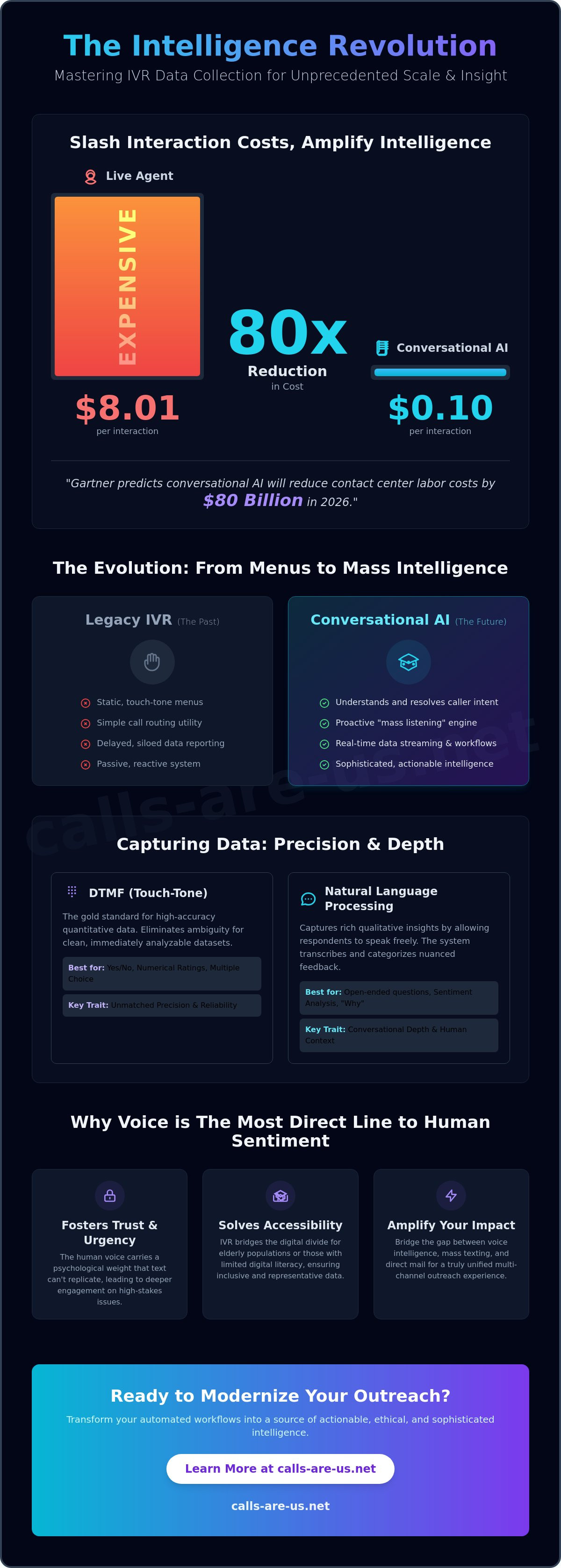
Why pay $8.01 for a single live agent interaction when you can achieve the same result for just $0.10? Gartner predicts that conversational AI will reduce contact center labor costs by $80 billion in 2026. This shift represents more than just a budget adjustment; it's a fundamental evolution in how we gather intelligence. Mastering IVR data collection allows your organization to scale outreach, capture high-volume insights, and maintain a competitive edge. It's time to move beyond the limitations of manual polling and embrace a system that works as fast as your data demands.
You likely recognize the frustration of watching response rates plummet while the costs of live calling centers continue to climb. It's difficult to build a visionary strategy when your data is trapped in silos or delayed by slow reporting cycles. This guide promises to transform your approach by turning automated workflows into a source of actionable, ethical, and sophisticated intelligence. We'll navigate the complexities of the 2026 regulatory environment, from the SECURE Data Act proposals to the nuances of evolving data privacy legislation. You'll learn to build seamless CRM integrations that respect consumer trust while driving unprecedented growth.
Key Takeaways
Modernize your outreach by transitioning from static touch-tone menus to conversational AI that understands and resolves caller intent.
Accelerate your decision-making through real-time data streaming and automated workflows that facilitate immediate campaign optimizations.
Redefine your strategy by utilizing IVR data collection as a proactive "mass listening" engine for rapid audience identification and sentiment analysis.
Boost engagement and ensure compliance by applying human-centric design principles that treat every automated interaction as a meaningful connection.
Amplify your impact by bridging the gap between voice intelligence, mass texting, and direct mail for a truly unified multi-channel experience.
Table of Contents
The Evolution of IVR Data Collection: From Menus to Intelligence
Speed defines the modern intelligence cycle. Organizations that rely on legacy reporting cycles find themselves reacting to yesterday's problems while their competitors anticipate tomorrow's needs. In this environment, IVR data collection has transformed from a passive call-routing utility into a proactive engine for mass intelligence. It's an active, automated dialogue that allows you to gather feedback from thousands of individuals simultaneously. By 2026, the focus has shifted entirely toward intelligence-first communication; every interaction is an opportunity to learn, refine, and lead with precision.
The core technology has matured significantly. Historically, Interactive voice response (IVR) served as a simple gatekeeper, using basic logic to move callers from one point to another. Today, it functions as a sophisticated listener. It bridges the gap between digital speed and the human voice, offering a level of scale that live calling centers simply can't match. This evolution empowers leaders to capture high-stakes data without the overhead of massive administrative teams.
DTMF vs. Natural Language Processing (NLP)
Precision is the hallmark of Dual-Tone Multi-Frequency (DTMF) input. Touch-tone responses remain the gold standard for high-accuracy quantitative data because they eliminate ambiguity. When you need a clear "yes" or "no," or a numerical rating, keypad input provides a clean dataset ready for immediate analysis. It's reliable, fast, and universally understood.
Conversely, Natural Language Processing (NLP) introduces conversational depth. Modern systems now use NLP to capture qualitative insights that were previously lost to automation. This technology allows respondents to explain their reasoning in their own words, which the system then transcribes and categorizes. By combining the two, you can build surveys that are both mathematically sound and rich with human context. You gain the ability to listen, interpret, and act on nuanced feedback in real time.
Why Voice Still Dominates the Data Landscape
Voice carries a psychological weight that text can't replicate. While email and SMS are efficient, the human voice fosters a sense of trust and urgency that's essential for high-stakes outreach. When a person hears a clear, professional voice, they're more likely to engage deeply with the questions being asked. This connection is the foundation of successful advocacy and research.
Voice also solves the accessibility crisis. Many demographics, including elderly populations or those with limited digital literacy, find traditional web forms or complex apps exclusionary. IVR bridges this gap by providing a familiar, low-friction interface. It ensures your IVR data collection efforts are inclusive, representative, and reflective of the entire audience you serve. In a world of fragmented digital channels, the phone remains the most direct line to authentic human sentiment.
How Modern IVR Systems Capture and Process High-Stakes Data
Data is the foundation of every high-stakes decision. In a landscape where timing is everything, modern IVR data collection systems act as a bridge between raw feedback and strategic command. They follow a methodical workflow that begins with a precision broadcast and ends with a crystal-clear visualization of audience sentiment. This isn't just about recording responses; it's about creating a responsive ecosystem where voice, data, and action work in perfect harmony. When your technology functions as a mentor-like guide, it simplifies the complex task of managing thousands of simultaneous interactions.
Real-time streaming allows you to pivot your campaign within minutes, not days. If a specific message isn't resonating with your audience, you see it on your dashboard immediately. Research on IVR data collection in surveys highlights how these systems maintain high engagement across diverse groups, making them invaluable for capturing representative samples under tight deadlines. By integrating these insights directly into your operations, you move from reactive management to visionary leadership. If you are ready to modernize your workflow, exploring an integrated IVR solution can bridge the gap between capture and action.
The Backend: Database Integration and APIs
Your outreach is only as strong as your connectivity. Modern IVR systems don't exist in a vacuum; they connect directly to high-capacity CRMs like Salesforce or NGP VAN. This seamless link ensures that every piece of data captured during a call is instantly reflected in your central database. API integration serves as the nervous system of modern outreach, pulsing information between platforms to trigger immediate follow-up actions. For example, a specific keypad response can automatically deploy a text message or update a donor profile, ensuring no lead is left stagnant. This automated coordination allows your team to focus on high-level strategy rather than manual entry.
Real-Time Analytics and Reporting
By 2026, the industry has moved decisively from batch processing to live dashboarding. You no longer wait for a file export to understand your campaign's performance. Instead, you watch live metrics that reveal trends as they happen. Sophisticated sentiment analysis now applies to voice-recorded data, allowing you to categorize the emotional tone of open-ended responses. This level of clean, structured data is essential for executive-level decision making, providing the clarity needed to justify budgets and refine long-term goals. When your reporting is instantaneous, your ability to lead is unmatched.
Beyond Customer Service: Strategic Applications in Advocacy and Campaigns
Effective advocacy requires more than just a loud message. It requires a deep, scalable understanding of what your constituents actually value. While many critics dismiss automated outreach as "robocalling," sophisticated organizations recognize IVR data collection as a vital tool for mass listening. It's a method for giving thousands of people a seat at the table simultaneously. By shifting the focus from talking at an audience to listening to them, you transform a simple phone call into a force for social progress and democratic inclusivity.
This technology empowers leaders to move with agility in high-pressure environments. Whether you are managing a national campaign or a local grassroots movement, the ability to gather sentiment instantly is a competitive necessity. It allows you to build a bridge between high-level strategy and the lived experiences of the people you serve. In 2026, the organizations that lead are those that can capture, analyze, and act on feedback faster than the news cycle can change.
Voter Identification and Polling
Precision segmentation is the heartbeat of a winning campaign. You can use automated systems to categorize a national audience into three distinct groups: the unwavering base, the persuadable middle, and the opposition. This process allows you to allocate resources with surgical accuracy, ensuring your message reaches the right ears at the right time. Automated polling provides a significant cost-per-response advantage, especially when compared to the $8.01 average cost of a live agent contact. By utilizing IVR data collection, you can conduct daily tracking polls that provide a granular view of shifting voter sentiment without exhausting your budget. It turns the phone into a high-speed intelligence engine that delivers mathematical certainty in an uncertain political climate.
Advocacy Mobilization and Crisis Response
Action must be immediate when a crisis strikes or a critical vote looms. Patch-through calling allows you to connect constituents directly with their legislators, turning a passive survey into an active mobilization tool. This seamless transition from data gathering to direct action ensures that the voices of your community are heard in the halls of power. Beyond mobilization, automated systems play a crucial role in emergency national notifications and public affairs crises. They allow you to distribute vital information quickly, gather immediate feedback on public safety needs, and maintain a clear line of communication when every second counts. This approach doesn't just manage a crisis; it fosters trust through transparency and rapid response.
Designing for Response: Best Practices for Ethical Data Gathering
Ethics isn't a limitation; it's your greatest asset. High response rates in IVR data collection are a direct byproduct of respectful, human-centric design. When you approach an automated interaction with the same integrity as a live conversation, you build a foundation of trust that digital forms simply cannot achieve. This commitment to transparency ensures your audience feels heard, valued, and respected throughout the process. By 2026, the most successful organizations have abandoned aggressive, high-pressure tactics in favor of a sophisticated, mentor-like approach that guides the participant through a logical and rewarding dialogue.
Designing for response requires a delicate balance between speed and meaningful interaction. You must respect the caller's time while providing enough context to make the engagement feel significant. This approach prioritizes relationship-building over simple data harvesting, ensuring that every interaction strengthens the bond between your organization and your audience. When you treat the participant as a partner in progress, the quality of your intelligence improves exponentially.
The Anatomy of a High-Converting Script
A successful script follows a precise sequence designed to maximize clarity and engagement. This methodical structure ensures the participant remains focused and motivated from the initial hook to the final close:
The Hook: Open with an assertive and transparent introduction that identifies your organization immediately. This establishes authority and removes the ambiguity that often leads to early hang-ups.
The Ask: Present clear, concise questions using consistent rating scales. Avoid complex logic that might confuse the participant; instead, focus on a flow that feels intuitive and effortless.
The Close: End with a sincere thank you and provide empowering next steps. Let the participant know how their data will be used to drive social progress or improve services.
Compliance as a Competitive Advantage
Integrity is the ultimate differentiator in a crowded market. Maintaining strict TCPA compliance isn't just about avoiding the $500 to $1,500 per-violation penalties; it's about protecting your brand's reputation. As of February 2024, the FCC officially classifies AI-generated voices as "artificial," making them fully subject to these regulations. Additionally, rules that took effect in April 2025 mandate that you must honor opt-out requests within 10 business days. This level of "Legal Safety" ensures your outreach remains ethical and sustainable.
Ethical data collection builds long-term trust and ensures your audience list remains healthy and engaged. By implementing robust opt-out mechanisms and respecting universal opt-out signals required by the Oregon Consumer Privacy Act as of January 2026, you demonstrate a commitment to consumer rights. This proactive stance transforms compliance from a mandatory checklist into a strategic advantage that fosters inclusive dialogue. If you're ready to build a campaign that is both powerful and principled, you can launch your compliant IVR workflow with our expert team today.
Integrating IVR Intelligence into Your Multi-Channel Outreach Strategy
Isolation is the enemy of efficiency. In a fragmented media environment, your IVR data collection shouldn't exist in a silo. It acts as the connective tissue that binds your various outreach channels into a single, cohesive intelligence engine. By 2026, the most successful campaigns use voice data to inform every other touchpoint, ensuring that your message is always relevant and timely. This integrated approach transforms your strategy from a series of disconnected efforts into a unified force for impact.
Voice intelligence provides the blueprint for your entire multi-channel ecosystem. When you understand the specific concerns of an individual through a voice interaction, you can refine your texting, target your mailers, and optimize your live calls with surgical precision. This feedback loop ensures that you're not just broadcasting a message, but facilitating a meaningful, ongoing conversation. It's about building a relationship that spans multiple platforms while maintaining a consistent and trustworthy voice.
The Multi-Channel Feedback Loop
Modern communication follows a rhythmic loop. A high-quality direct mail piece often serves as the initial spark, using a dedicated phone number to drive recipients toward an IVR-based town hall or research survey. Once the participant engages, the data captured during that call instantly refines your 10DLC-compliant texting campaign. If a respondent identifies a specific priority during the IVR data collection phase, they receive an automated text follow-up that addresses that exact need. This synergy extends to your live calling center as well. Automated systems can effectively filter a high-volume audience, allowing your professional agents to focus their energy on the most complex or high-value interactions. This tripartite strategy of mail, voice, and text ensures that no lead is wasted and every interaction is optimized for conversion.
Partnering with Calls-Are-Us for Scalable Impact
Scale requires a partner who has navigated the highest levels of influence. Calls-Are-Us brings a history of operating in over 40 states, providing the infrastructure and expertise needed for massive national campaigns. We don't just provide technology; we offer an authoritative visionary approach to high-volume communication. Our team understands the nuances of regulatory compliance, the psychology of voice engagement, and the technical requirements of complex CRM integrations. We're committed to fostering connections that drive social progress and organizational success.
Transformation begins with a single strategic pivot. You have the opportunity to move beyond traditional, slow-moving reporting and embrace a real-time intelligence stack that empowers your entire team. We invite you to book a consultation today to design a custom outreach technology stack that meets your unique goals. Let us facilitate your transition to a more sophisticated, ethical, and effective communication model. Together, we can turn high-volume outreach into a lasting legacy of impact.
Leading the Future of Audience Intelligence
The nature of automated communication has shifted from simple call routing to a sophisticated intelligence engine. By embracing conversational AI and real-time analytics, your organization can move beyond static data and begin fostering genuine, high-stakes connections. You now have the tools to bridge the gap between digital scale and human voice, ensuring every interaction delivers actionable insights while maintaining strict ethical standards. This evolution allows you to listen to your audience at an unprecedented scale.
Success in 2026 requires more than just technology; it demands a partner with a proven track record of integrity and impact. Calls-Are-Us has operated in over 40 states supporting national elections, providing the scale and expertise needed for high-pressure environments. Our TCPA-compliant automated workflows and integrated multi-channel outreach including P2P and Direct Mail ensure your IVR data collection remains both powerful and principled. It's time to transform your outreach into a legacy of inclusive dialogue and strategic growth.
Discover how Calls-Are-Us can scale your data intelligence today. We're ready to help you navigate the complexities of modern communication with confidence and precision. Your mission deserves a voice that carries weight, and we're here to help you find it.
Frequently Asked Questions
Is IVR data collection legal for political campaigns in 2026?
Yes, automated data gathering remains a legal and vital tool, provided you adhere to evolving federal and state regulations. The FCC officially classified AI-generated voices as artificial voices in February 2024, meaning they're subject to full TCPA standards. You must also account for state-level requirements, such as the expanded scope of the Connecticut Data Privacy Act that took effect on July 1, 2026.
How do IVR surveys compare to online surveys in terms of response rates?
IVR often captures a more representative sample by bridging the accessibility gap for non-digital demographics. While online surveys are efficient for certain groups, voice interactions foster a sense of urgency and trust that text-based forms lack. Research from organizations like Pew indicates that call-in options are essential for reaching diverse populations and ensuring data integrity across age and income brackets.
Can IVR systems collect qualitative voice recordings, or only keypad inputs?
Modern systems capture both structured keypad data and nuanced qualitative recordings. Natural Language Processing (NLP) allows your organization to transcribe, categorize, and analyze open-ended voice responses automatically. This combination provides the mathematical precision of touch-tone input alongside the rich emotional context of human speech, creating a comprehensive intelligence profile.
How does IVR integrate with my existing CRM like Salesforce or NGP VAN?
Integration occurs through secure APIs that pulse data directly into your central database in real time. This connection functions as the nervous system of your campaign, ensuring that every response immediately updates voter profiles or donor records. These automated workflows can then trigger follow-up actions, such as a personalized text message or a direct mail send, based on the specific data captured.
What is the typical cost-per-response for an automated IVR poll?
Automated interactions offer a significant cost advantage over live agent outreach. Industry data shows that while a live agent contact averages $8.01, a self-service interaction costs approximately $0.10. This efficiency allows you to scale IVR data collection across a national audience without the prohibitive expenses associated with a massive live calling center.
How do I ensure my IVR campaign stays TCPA compliant?
Compliance requires a proactive strategy that includes rigorous list scrubbing and clear opt-out mechanisms. You must honor consumer consent revocation requests within 10 business days, a requirement mandated by FCC rules that took effect in April 2025. Maintaining a transparent protocol for "Legal Safety" protects your organization from statutory penalties that range from $500 to $1,500 per violation.
Can IVR data collection be used for bilingual or multi-language outreach?
Yes, sophisticated IVR platforms facilitate inclusive dialogue by offering seamless multi-language support. Callers can select their preferred language at the start of the interaction, ensuring that your outreach is accessible and respectful. This capability is essential for building trust in diverse communities and gathering data that truly reflects the complexity of your entire audience.
What is the difference between IVR data collection and a standard robocall?
The fundamental difference lies in the interaction and the intent. A standard robocall is a one-way broadcast designed for mass delivery, while IVR data collection is a two-way, automated dialogue. It's a sophisticated "mass listening" engine that prioritizes feedback and engagement, transforming a passive message into an active source of intelligence and connection.



Comments