_edited.png)
Voice Broadcast Pricing: The 2026 Buyer’s Guide to Outreach Budgeting

Updated: Jun 18
The lowest per-minute rate in your voice broadcast pricing model is often the most expensive mistake your organization can make. While a bargain provider might look good on a spreadsheet, the hidden costs of low deliverability and regulatory non-compliance can quickly erode your mission's impact. You've likely experienced the frustration of unpredictable fees for interactive IVR menus or the sting of calls that never reach their intended destination. It's a high-stakes environment where every connection matters; your budget should reflect the value of those genuine human interactions.
We're here to help you master these financial complexities and build a high-ROI outreach budget that stands up to scrutiny. This guide provides the clarity you need to navigate 2026's shifting regulatory landscape, including the latest Robocall Mitigation Database requirements and proposed "Know Your Customer" verification rules. We will break down effective pricing structures, explore the importance of authentic AI voice licensing, and provide a roadmap for predictable national outreach that justifies every dollar of your spend.
Key Takeaways
Shift your focus from raw call volume to engagement-focused metrics that prioritize the quality and impact of every successful connection.
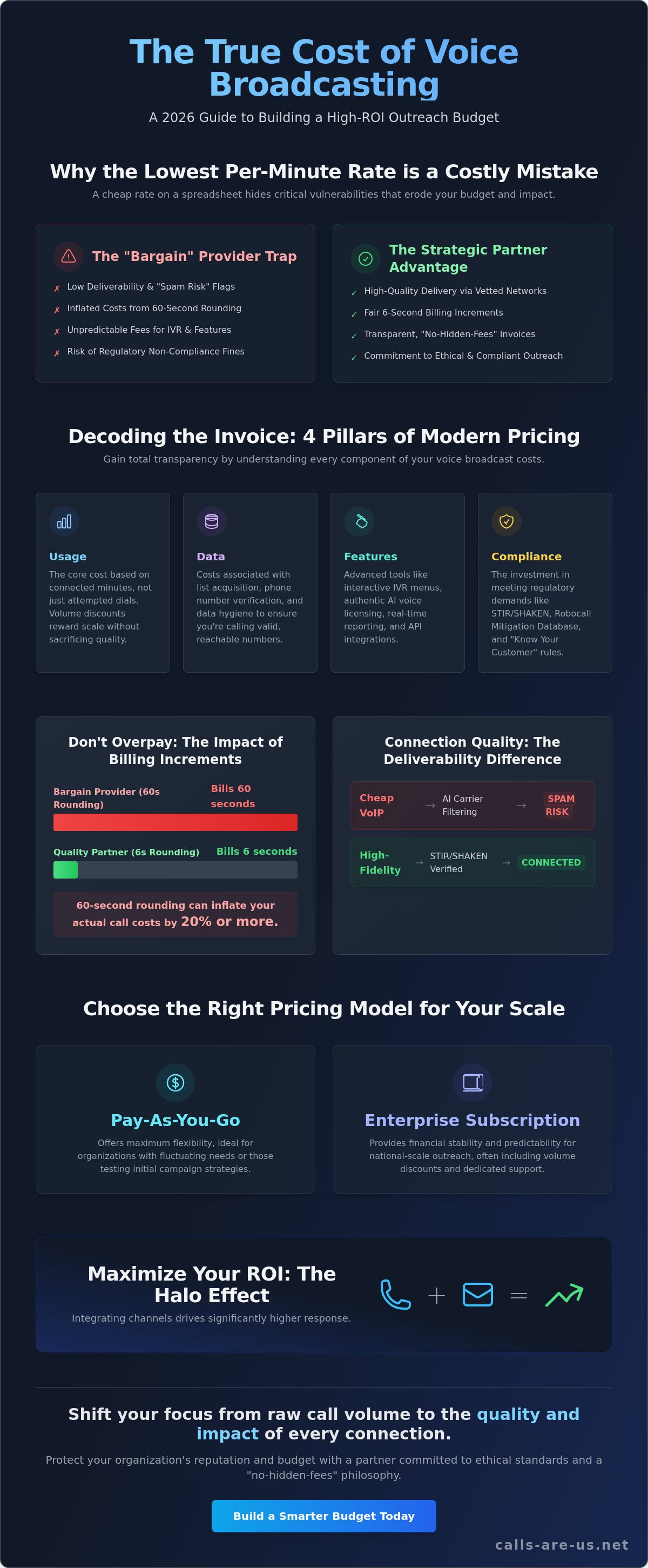
Identify the four critical pillars of a modern invoice—usage, data, features, and compliance—to gain total transparency into your voice broadcast pricing.
Determine whether pay-as-you-go flexibility or a structured enterprise subscription model offers the best financial stability for your national-scale outreach.
Leverage the "halo effect" by integrating voice broadcasting with direct mail to drive significantly higher response rates across your multi-channel strategy.
Protect your organization’s reputation and budget by choosing a partner committed to ethical communication standards and a "no-hidden-fees" billing philosophy.
Table of Contents
The Evolution of Voice Broadcast Pricing in 2026
Effective communication requires more than just a list of phone numbers and a recording. In 2026, voice broadcast pricing has evolved into a sophisticated, multi-variable calculation that balances advanced technology, geographic reach, and strict regulatory compliance. The old "volume-at-all-costs" approach has been replaced by engagement-focused models that prioritize the quality of the connection over the quantity of the attempts. This shift reflects a deeper understanding of how modern carriers filter traffic and how recipients perceive automated outreach.
Successful organizations now adopt an "Authoritative Visionary" approach to their communication budgets. This philosophy treats every call as a vital interaction, an opportunity to foster trust, and a step toward social progress. By investing in high-quality delivery systems rather than the cheapest available routes, you ensure your message isn't just sent; it's heard. Understanding Voice broadcasting technology is the first step in building a budget that respects both your audience and your bottom line.
To better understand how this technology functions in a real-world setting, watch this helpful video:
Carrier filtering has become significantly more aggressive in 2026. Telecom providers now use complex AI algorithms to monitor traffic patterns and flag suspicious behavior in real time. This means that a low-cost, low-quality strategy will likely result in your calls being blocked before they even ring. A sophisticated budgeting approach accounts for these obstacles by investing in verified caller IDs and reputable delivery networks that maintain high deliverability rates.
Why Per-Minute Rates are Only the Starting Point
Base rates can be deceptive. Many providers lure customers with low headline prices but use 60-second rounding increments that can inflate your actual costs by 20% or more. Choosing a partner that uses 6-second rounding ensures you only pay for the time you actually use. You must also distinguish between "attempted calls" and "connected minutes" billing. In 2026, industry professionals report that focusing on connected minutes provides a much clearer picture of your actual ROI, as it ignores the noise of busy signals and unanswered attempts.
The Quality Premium: VoIP vs. High-Fidelity Landlines
Cheap VoIP routes are a primary target for carrier "Spam Risk" flags. These routes often lack the metadata required for proper STIR/SHAKEN authentication, leading to immediate filtering. Investing in high-quality copper or dedicated digital lines provides a level of clarity and reliability that justifies the higher price point. This is particularly critical for high-stakes environments, such as political voice broadcasting, where a single missed connection can alter the course of a campaign. High-fidelity lines ensure your brand sounds professional, trustworthy, and authoritative.
Decoding the Invoice: Key Factors Influencing Your Budget
Transparency is the bedrock of any successful partnership. When you examine a modern outreach invoice, you aren't just looking at a price tag; you're looking at a strategic breakdown of resources. A comprehensive voice broadcast pricing model is built upon four essential pillars: usage, data, features, and compliance. Each component plays a vital role in ensuring your message reaches its destination with clarity and integrity.
National-scale organizations often benefit from volume discounts that reward broader reach. As your campaign grows, the per-unit cost of engagement typically decreases, allowing for a more efficient allocation of capital. However, these discounts should never come at the expense of deliverability. A high-volume campaign that fails to connect is a wasted investment, regardless of the initial discount offered. Efficiency is found in the balance of scale and success.
Choosing a "cheap" provider is often a costly mistake in disguise. While low-tier VoIP routes might save pennies on the front end, they frequently lead to lost opportunities through blocked calls and poor audio quality. If your audience can't hear your message, or if their carriers flag your number as a risk, the "savings" evaporate instantly. Investing in premium delivery ensures that your organization's voice remains clear, professional, and authoritative. If you're ready to see how quality impacts results, you can explore our transparent outreach solutions today.
IVR Complexity and Interaction Costs
Interactive Voice Response (IVR) systems add a layer of sophistication that directly impacts your budget. Features like "Press-1" transfers and multi-level menus require additional processing power and billing time. Collecting real-time data through keypad inputs is an invaluable tool for engagement, but it necessitates a more complex technical setup. You can review these voice broadcast message examples to see how complex scripts are structured to maximize these interactive features without inflating costs unnecessarily.
The Hidden Costs of Regulatory Compliance
Compliance isn't just a legal requirement; it's a budget item. Managing National Do Not Call (DNC) lists and performing TCPA scrubbing involves dedicated technology and oversight. These safeguards protect your organization from significant legal risks and ensure you remain aligned with FCC regulations on robocalls. Additionally, carrier pass-through fees and 10DLC registration costs for integrated campaigns are often billed separately from the base rate, making it essential to account for them in your initial outreach budget.
Data Hygiene and List Management Fees
Paying for "dead air" is the fastest way to kill a campaign budget. High-quality list management involves regular scrubbing to remove disconnected numbers and non-working lines before the first call is ever made. Utilizing vendor-provided scrubbing services often yields a much higher ROI than working with raw, unverified lists. This commitment to data hygiene reflects a broader philosophy of integrity; it ensures that your resources are focused on meaningful interactions with real people rather than shouting into the void.
Choosing the Right Pricing Model for Your Scale
Alignment drives efficiency. Selecting a pricing model isn't merely a financial transaction; it's a strategic commitment to your organization’s operational rhythm. As you scale your outreach, the way you consume and pay for minutes must evolve to match your campaign’s lifecycle. Understanding how voice broadcast pricing shifts between flexible and committed structures allows you to maintain momentum without overextending your resources. It's about finding the sweet spot where technological capability meets budgetary discipline.
Your choice of model reflects your broader philosophy of engagement. Whether you're reacting to a sudden legislative shift or building a multi-year advocacy foundation, your financial framework should empower your mission rather than restrict it. Sophisticated leaders look beyond the immediate invoice to see how a pricing structure facilitates long-term growth and social impact. By aligning your costs with your connection goals, you transform a line item into a powerful engine for progress.
Pay-As-You-Go: Flexibility for Rapid Response
Agility is the primary asset of the pay-as-you-go model. This structure is ideal for short-term advocacy pushes, emergency notifications, or rapid-response scenarios where speed is more critical than long-term planning. You gain the tripartite benefit of agility, speed, and zero upfront commitment. While per-minute rates may be slightly higher than subscription tiers, the lack of a monthly contract provides a "no-nonsense" flow that suits organizations with fluctuating outreach needs. It's a high-performance tool for leaders who need to act decisively in the moment.
Subscription Tiers: Predictability for Ongoing Outreach
Predictability fuels long-term success. For non-profits and year-round political organizing, a subscription model provides a steady heartbeat for your outreach efforts. These tiers offer the stability of a fixed monthly cost, significantly lower per-minute rates, and dedicated support channels. When evaluating these pools, it's essential to understand how your usage aligns with the Telemarketing Sales Rule (TSR) to ensure every minute is used ethically and effectively. This model rewards consistency, allowing you to build deeper relationships with your audience over time through a predictable, high-ROI budget.
Custom Enterprise Solutions for National Campaigns
National scale requires a bespoke approach. When your campaign reaches multi-million minute volumes, standard tiers no longer provide the necessary depth of service. Enterprise solutions offer negotiated rates, technical priority, and strategic oversight that smaller models simply can't match. This "Authoritative Visionary" level of service includes dedicated account managers who act as partners in your mission. They help you navigate the complexities of national-scale communication, ensuring your budget is optimized for the highest possible level of deliverability and human impact across the country.
Maximizing ROI: Strategic Budgeting for Multi-Channel Outreach
True ROI is a product of synergy. While analyzing voice broadcast pricing in isolation is necessary for line-item budgeting, the most impactful results emerge when you view these costs through the lens of a mass communication strategy. By layering voice interactions with other high-touch channels, you create a "halo effect" that amplifies the effectiveness of every dollar spent. This integrated approach transforms a simple broadcast into a multi-dimensional dialogue that fosters genuine connection and social progress.
Effective budgeting requires a balanced allocation across voice, text, and physical mail. A campaign that relies solely on one channel risks being filtered out by the noise of modern life. Instead, sophisticated organizations use voice broadcasting to establish authority, peer-to-peer texting to facilitate direct engagement, and direct mail to provide a tangible, lasting presence. This tripartite structure ensures your message is delivered with clarity, urgency, and relevance, justifying the total investment through significantly higher conversion rates.
Voice and SMS: The One-Two Punch
Engagement rates vary significantly between voice and text. While mass texting offers a lower cost-per-contact, voice broadcasting provides a humanized depth that digital text often lacks. Budget efficiency is maximized when you follow a voice broadcast with a personalized P2P text, a sequence that acknowledges the initial call and provides an immediate digital pathway for action. In 2026, the cost-efficiency of these integrated digital workflows has become a primary driver for national organizations looking to optimize their outreach spend without sacrificing the personal touch that builds trust.
Integrating Physical Outreach: The Direct Mail Factor
Physical mail remains a powerful tool for high-impact voter and donor outreach. You can review our political direct mail strategy to see how these costs are structured for 2026 campaigns. The ROI of physical outreach increases dramatically when a household is "primed" with a voice call a few days before the mail arrives. This sequence increases name recognition and ensures the physical piece is met with familiarity rather than indifference. To justify this total spend, you must track multi-channel attribution, measuring how the combination of voice and mail drives more actions than either channel could achieve alone. If you are ready to maximize your impact, you can design your multi-channel outreach budget with our expert team.
The Calls-Are-Us Advantage: Transparent Pricing for High-Impact Results
Integrity is the foundation of every connection. At Calls-Are-Us, we believe that voice broadcast pricing should be as clear and reliable as the audio we deliver to your audience. We've built our reputation on a sophisticated blend of high-stakes authority and approachable partnership, prioritizing ethical communication and inclusive dialogue in every campaign. When you choose us, you aren't just selecting a vendor; you're enlisting a seasoned ally that has operated at the highest levels of influence across more than 40 states.
Hidden "gotcha" fees have no place in a principled communication strategy. We've eliminated the opaque setup costs and surprise regulatory pass-throughs that often plague the industry, providing a billing model that rewards transparency and trust. This commitment to honesty allows you to focus on what truly matters: the potential for impact and the importance of fostering genuine relationships. We move beyond the transactional to champion a philosophy of open, meaningful outreach that respects your budget and your mission.
Scalability Without Friction
Momentum shouldn't be stalled by technical limitations or rigid pricing structures. Our platform is engineered to handle the massive spikes in volume that define critical election weeks and rapid-response advocacy pushes without a hint of friction. Because we maintain long-standing, robust relationships with tier-one carriers, we provide a level of pricing stability and deliverability that newer providers simply can't match. You gain the tripartite benefit of technical resilience, predictable costs, and the ease of moving between service tiers as your campaign’s needs evolve in real time.
Expert Strategic Support Included
Technology is a powerful tool, but it's most effective when guided by expert strategy. While many competitors offer nothing more than a cold, self-service portal, we provide a dedicated consultant to serve as a principled guide for your organization. This "Confident Mentor" approach ensures you aren't left to guess during the budgeting process. We help you optimize your voice broadcast pricing by identifying the most efficient pathways for connection, ensuring every dollar spent contributes to social progress and measurable results.
Impact is the ultimate metric of success in modern outreach. We're dedicated to helping you transform your campaign from a series of broadcasts into a powerful engine for change and connection. Partner with Calls-Are-Us for transparent, high-impact voice broadcasting and ensure your organization's voice is heard with the clarity and authority it deserves.
Securing Your Organization’s Voice for the Road Ahead
Success in 2026 isn't measured by how many calls you launch; it's measured by how many connections you solidify. You now understand how mastering the variables of voice broadcast pricing allows your organization to move from reactive spending to proactive, high-ROI investment. By prioritizing high-fidelity delivery, rigorous compliance, and strategic multi-channel integration, you ensure your message resonates with the authority it deserves. Every budget choice you make is an opportunity to strengthen the trust between your organization and the communities you serve.
We bring specialized public affairs expertise and a proven track record of operating in over 40 states to every partnership we form. Our team provides the strategic oversight needed to navigate complex regulatory landscapes while seamlessly integrating voice, text, and direct mail into a single, cohesive engine for change. You can Request a Transparent Quote for Your National Outreach Campaign to start building a budget that prioritizes human impact over mere transactions. Your mission is too important to leave to chance. It's time to foster the connections that drive real social progress and lasting results.
Frequently Asked Questions
What is the average per-minute rate for voice broadcasting in 2026?
Industry rates typically range from 0.7 cents to 2.5 cents per minute depending on your total volume and order size. These figures represent the baseline technical cost for delivery across the United States and Canada. High-stakes organizations should view these rates as a starting point, as premium delivery routes and strategic oversight often require a more nuanced investment to ensure high deliverability and audio clarity.
Are there hidden fees for setting up a political voice broadcast campaign?
Transparency is the bedrock of a professional partnership. While some providers might surprise you with undisclosed setup costs or compliance surcharges, an authoritative partner provides a clear breakdown from the start. You should verify whether your quote includes data scrubbing, TCR registration, and state-specific regulatory filings. These components are essential for maintaining integrity and avoiding the "gotcha" fees that can derail a campaign budget.
How do IVR "Press-1" transfers affect my total billing?
Interactive features impact your budget by extending the duration of the active connection. When a recipient engages with a menu or transfers to a live agent, the billing continues for the entire length of that human interaction. Efficiently designed scripts help manage these costs by providing clear options that respect the recipient's time. This approach maximizes the value of the data collected while keeping the total interaction time within your budgetary goals.
Is there a difference in pricing between cell phones and landlines?
Technical pricing is generally consistent across both device types, but the regulatory requirements for each differ significantly. Calls to wireless numbers require specific consent under FCC regulations, which can influence your initial data acquisition and scrubbing costs. A sophisticated voice broadcast pricing model accounts for these differences, ensuring your organization remains compliant while reaching both mobile and residential lines with equal reliability and professional clarity.
Do I have to pay for calls that go to voicemail or are busy?
Most professional billing models focus on successful connections rather than raw attempts. You typically pay for calls that reach a live person or an answering machine, as your message is successfully delivered in both scenarios. Busy signals or non-working numbers are generally excluded from usage billing in engagement-focused models. This ensures your resources are directed toward actual message delivery rather than technical failures or "dead air" on the line.
How does volume affect the cost of national voice broadcast campaigns?
Scale drives significant operational efficiency. National organizations benefit from lower per-unit costs as their total minute volume increases, rewarding the breadth of their outreach. These volume discounts allow for a more aggressive strategy, enabling you to reach millions of households while maintaining a sustainable cost-per-connection. It's a tripartite benefit of lower rates, broader reach, and the ability to maintain a consistent presence across multiple regions simultaneously.
What are the carrier pass-through fees for 10DLC compliance?
Major carriers have implemented pass-through fees to maintain the integrity of the 10-digit long code ecosystem. These fees are set by the telecom providers themselves and are typically passed directly to the organization without markup. While these costs are a standard part of the modern outreach landscape, a transparent partner will list them as separate line items. This clarity prevents unexpected impacts on your budget and ensures your integrated campaigns remain fully verified.
Can I get a discount for bundling voice, text, and direct mail?
Integrated outreach often provides superior financial and operational value. Bundling voice broadcasting with peer-to-peer texting and direct mail creates efficiencies that can lead to a more favorable overall investment compared to managing each channel in isolation. This holistic approach doesn't just optimize your spend; it amplifies your total impact by ensuring your message is reinforced across multiple touchpoints. It's a strategic way to build trust and drive higher response rates through a coordinated, authoritative presence.



Comments